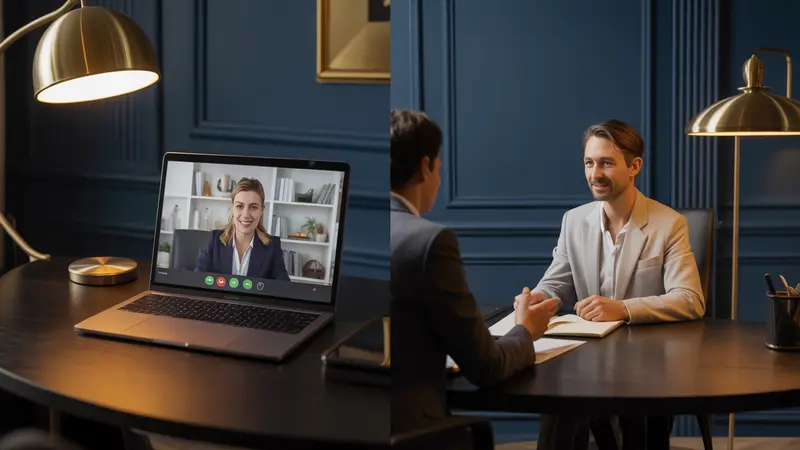
If you're considering coaching, you've probably wondered: does it work as well over a screen as it does face-to-face?
It's a fair question with a surprising answer. The evidence consistently shows that online coaching is equally effective as in-person coaching for most outcomes — and in certain respects, it's actually superior.
But the full picture is more nuanced than a simple "online wins" or "in-person wins." The right format depends on your specific needs, preferences, and circumstances. Let me walk you through what the research shows and help you make an informed choice.
What the Research Says
A 2024 meta-analysis published in *Coaching: An International Journal of Theory, Research and Practice* examined 38 studies comparing online and in-person coaching outcomes. The findings were clear:
- **No significant difference** in goal attainment, self-efficacy, or well-being outcomes between formats
- **Client satisfaction** was equivalent across both modalities
- **Therapeutic alliance** (the quality of the coach-client relationship — the single strongest predictor of coaching effectiveness) showed no significant difference
- **Completion rates** were actually higher for online coaching — clients were less likely to cancel or drop out
This mirrors findings from the psychotherapy literature, where 15+ years of research on teletherapy has established virtual delivery as an evidence-based modality.
The bottom line: if you're avoiding coaching because you assume online won't work as well, the evidence doesn't support that assumption.
Where Online Coaching Excels
Accessibility and Consistency
This is the single biggest advantage. Online coaching eliminates travel time, parking logistics, and the practical barriers that cause cancellations. When your session is a click away rather than a 40-minute drive, you're far more likely to show up — especially during the weeks when you need coaching most (which are, inevitably, the weeks when you're most stretched for time).
For executives with demanding schedules, travel commitments, or irregular hours, online coaching isn't a compromise — it's the only format that provides consistent access.
Geographic Freedom
In-person coaching limits you to coaches within reasonable travel distance. Online coaching gives you access to the right coach, not just the nearest one.
If your specific situation requires a coach who has worked with senior leaders in your industry, who understands UK corporate culture, and who specializes in burnout recovery — the chances of that person being within 30 minutes of your home are slim. Online removes this constraint entirely.
Environmental Comfort
There's a counterintuitive finding in the research: some clients are more open and vulnerable in online sessions than in-person ones. The slight distance of a screen can actually reduce performance anxiety — the sense of being "observed" — and allow deeper honesty.
This is particularly relevant for executives who've spent decades managing their image in professional settings. The slight buffer of a screen can help them drop the armour faster.
Between-Session Integration
Online coaching naturally integrates with digital tools: shared documents, voice notes, messaging, journaling apps, and assessment platforms. This creates a richer between-session experience and more touchpoints for accountability and support.
Privacy and Discretion
No one sees you walking into a coaching office. No colleague spots you in the waiting room. For senior leaders who are concerned about perception (rightly or wrongly), online coaching provides complete discretion.
Where In-Person Coaching Excels
Somatic and Embodied Work
If your coaching involves body-based awareness — noticing where you hold tension, working with breath, exploring physical responses to stress — in-person creates a richer environment. Coaches can observe your full body language, posture shifts, and energy changes in ways that a screen constrains.
For burnout recovery specifically, somatic awareness is valuable. Your body has been keeping score — and accessing that information is sometimes easier in a shared physical space.
Depth of Presence
There's a quality of attention that physical co-presence creates that's difficult to replicate digitally. The absence of screen fatigue, notification distractions, and technical glitches means that attention can be more fully sustained.
This matters most in sessions dealing with deep emotional material — grief, loss, identity crisis, or trauma-adjacent experiences. If you're processing the loss of a career identity or the impact of years of self-neglect, the warmth of a shared physical space can feel genuinely containing.
Ritual and Transition
For some clients, the physical act of traveling to coaching creates a valuable transition ritual. The drive or walk becomes a mental preparation — a shift from the operational to the reflective. The dedicated physical space signals to your brain: "This is different from normal life. This is where I think differently."
If your home environment is associated with work (the laptop, the home office, the domestic to-do list), conducting coaching from the same space can undermine the sense of stepping outside your normal frame.
Relationship Building in Early Sessions
While research shows that therapeutic alliance develops equally well in both formats over time, some coaches and clients find that the first 1-2 sessions benefit from in-person connection. Face-to-face interaction builds rapport slightly faster through micro-expressions, handshakes, and the social information that physical meeting provides.
The Hybrid Model
Increasingly, the most effective approach isn't either/or — it's both.
A hybrid model might look like:
- **In-person** for the initial deep-dive session (building relationship, comprehensive assessment)
- **Online** for regular fortnightly or weekly sessions (maintaining momentum and accessibility)
- **In-person** for quarterly reviews or intensive breakthrough sessions
- **Online** for crisis or time-sensitive support between scheduled sessions
This gives you the relational depth of in-person connection with the practical sustainability of online access.
How to Choose
Ask yourself these questions:
1. What's your schedule reality? If you're traveling frequently, working 50+ hour weeks, or managing unpredictable demands, online coaching provides the consistency that in-person can't.
2. Where are you geographically? If the right coach isn't local, online is your access point. Don't settle for a less-qualified local coach when a better-matched one is available virtually.
3. What's your home environment? If you have a private, comfortable space for video calls, online works beautifully. If you're sharing a flat with a partner and two children, finding privacy for deep coaching conversations might be challenging.
4. What type of work do you need? Strategic career planning, decision-making support, and accountability translate perfectly online. Deep somatic or embodied work may benefit from in-person space.
5. What's your preference? This matters. If you strongly prefer one format, that preference will affect your engagement and outcomes. Honor it.
The Technology Question
Online coaching only works if the technology is reliable. Minimum requirements:
- Stable internet connection (wired is better than wireless)
- A private, quiet space where you won't be interrupted
- Good audio (a headset or quality microphone — laptop speakers create distance)
- Camera on (non-negotiable for most coaches, and for good reason — visual cues are essential)
- Notifications off, phone in another room, browser tabs closed
The biggest threat to online coaching effectiveness isn't the format — it's distraction. If you're "multitasking" during a session, you've already undermined the value. Full presence is required regardless of medium.
My Practice
I work primarily online, with in-person sessions available in London for clients who prefer face-to-face interaction. The online format allows me to work with executives across the UK and internationally, maintaining consistent session schedules that don't get disrupted by travel or diary chaos.
Every engagement starts with a Freedom Mapping Call — conducted online — which gives you an immediate experience of what virtual coaching feels like with me specifically. You'll know within 30 minutes whether the format works for you.
The question isn't online vs in-person. It's: are you ready to invest in the conversation that changes everything?
The format is secondary. The commitment is what matters.
The Move From Here
Look — what you've just read is the diagnosis. I wrote The Freedom Reset Blueprint as the system: forty pages, the complete R.E.S.E.T. Framework, the same one I had to build from scratch when nobody else had a map for it. It's not another book about burnout. It's the operating manual for getting your wiring sorted, your calendar back, and your evenings to feel like yours again — priced so the cost is never the reason you didn't move.
You've spent enough time figuring this out alone — at 11pm, in the car park, in the silence between meetings. That's already cost you more than this will. The longer you sit with it, the heavier it gets. Don't bookmark this. Open it.